

From Easter Eggs to Extra Cheese: What Pizza Reveals About Modern OSINT
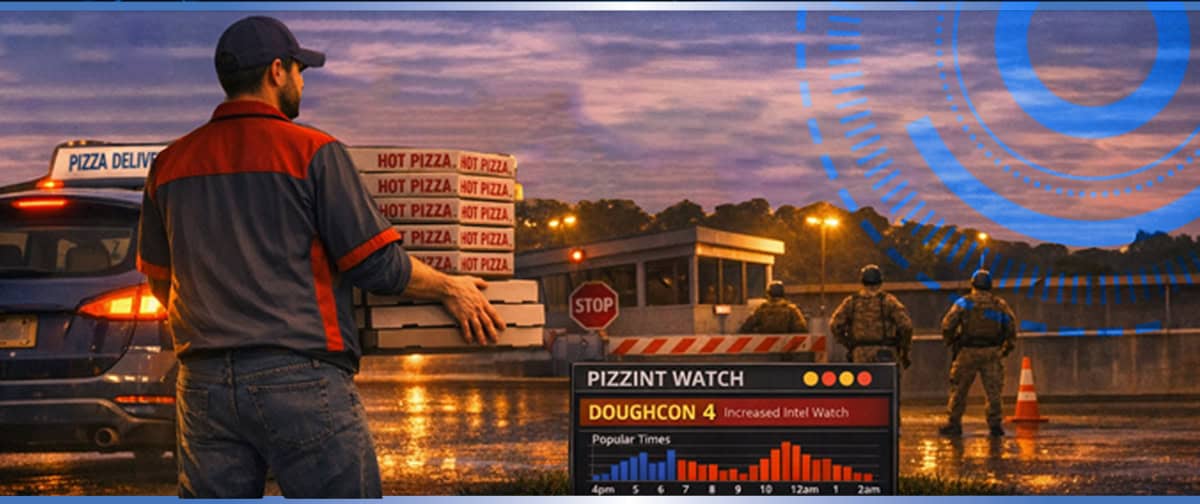
Sometimes, intelligence hides in plain sight. Modern OSINT increasingly draws on everyday, openly available data to identify weak signals and emerging patterns.
With Easter just behind us, OSINT practitioners are no strangers to the thrill of finding so called Easter eggs – small, seemingly throwaway details that point to something bigger. Occasionally, those hidden signals are not buried in metadata or leaked documents, but sitting right under our noses, or more accurately, waiting at the Pentagon gates in a pizza delivery car.
Welcome to the enduring, and surprisingly resilient, story of the Pentagon Pizza Index which is a good reminder of the power of open-source intelligence.
An Unconventional Signal | Modern OSINT
Most indicators of an impending geopolitical event are obvious once you know where to look – official briefings, force mobilizations, aircraft movements, diplomatic statements. The Pentagon Pizza Index flips that logic on its head. Instead of watching the visible machinery of government, it focuses on something decidedly ordinary – late-night food orders, as a proxy for what cannot be seen.
The premise is simple: When senior defense and intelligence staff are staying late behind closed doors, delivery drivers notice first.
In 1990, a Domino’s delivery runner told TIME Magazine that pizza orders near the Pentagon would reliably spike the night before major military operations. According to the driver, Pentagon orders doubled the evening before the US invasion of Panama, a pattern that echoed ahead of the Grenada invasion.
The Origin Story: Desert Storm
The Pentagon Pizza Index gained its most frequently cited data point during the lead-up to Operation Desert Storm.
In January 1991, Deseret News reported that Frank Meeks, then a Domino’s franchise owner servicing Washington area government buildings, observed an extraordinary surge in late night deliveries. On the evening of January 15, the night before coalition strikes began, pizza orders to the Pentagon reportedly climbed from three to 101.
Meeks also noted a similar anomaly several months earlier. On August 1, 1990, the CIA set a one-night delivery record of 21 pizzas. Iraq invaded Kuwait the following morning.
From Urban Legend to modern OSINT Playbook
For decades, pizza intelligence lived in the space between myth and media trivia. It was repeated because it was funny, not because it was measurable. Tracking it required a delivery driver willing to talk, hindsight, and a healthy dose of speculation.
Today, the OSINT landscape looks very different.
Modern practitioners do not need insiders; they need openly available data at scale.
Enter Google Maps ‘Popular Times’ and ‘live busy’ indicators. These features were designed to help people avoid queues and time for planning dinner reservations. OSINT analysts saw something else, a real-time, anonymized signal of activity outside normal working hours.
The result is PizzINT Watch, a live dashboard that monitors busy data from pizza outlets around the Pentagon and aggregates them into a readiness style indicator known as DOUGHCON.
What began as a throwaway anecdote has been repackaged into a continuously refreshed, entirely open-source signal. This shift reflects how modern OSINT has moved from anecdote‑driven insights to systematic, repeatable analysis.
2025, Pizza INT Goes Mainstream
The Pentagon Pizza Index returned to broad public consciousness during the June 2025 Israel Iran escalation.
An X account associated with the Pizza INT dashboard, @PenPizzaReport, posted screenshots showing sudden activity spikes at multiple pizza establishments near the Pentagon around 7 PM on June 12. The data was sourced from Google’s live Popular Times indicators, nothing proprietaryproprietary, and nothing classified.
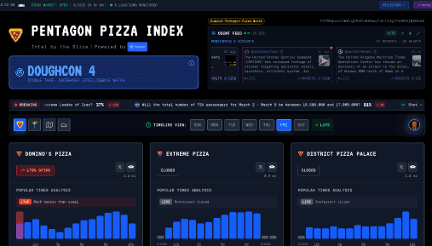
Screenshot of the PizzINT (Pentagon Pizza Index) dashboard on 6 March 2026, during heightened U.S.–Israel operations involving Iran, showing DOUGHCON 4 (“increased intelligence watch”) and live Google “Popular Times”/busyness-based activity readouts for eight Pentagon-area pizza locations, including a visible spike at Domino’s Pizza.
Later that night, Israel began strikes.
Fox Business covered the correlation, linking the timing of the reported surge to unfolding military operations and pushing Pizza INT beyond niche OSINT circles. What had once been an inside joke was now being discussed as a legitimate, if imperfect, early warning signal.
Why This Matters for Intelligence Professionals
For intelligence professionals working in modern OSINT, the challenge is not data scarcity, but signal interpretation. The Pentagon Pizza Index is not important because pizza orders cause wars, or even because they reliably precede them.
It matters because it demonstrates several core truths about modern intelligence work.
Signals do not have to be exotic to be valuable. Open data drawn from consumer platforms can reveal changing sentiment, urgency, or disruption in mission-relevant environments.
Context is everything. A busy pizza shop on a Friday night means nothing. A sustained deviation from historic patterns, during a period of geopolitical tension, might.
OSINT is evolving from anecdotes to systems. What once relied on human observation is now automated, monitored, and trend-analyzed, transforming folklore into a repeatable methodology.
At Fivecast, this shift is familiar. Effective OSINT today is not about finding a single clever data point. It is about correlating many weak signals, at scale, and understanding how they interact over time.
A Reminder Hidden in Plain Sight
There is a temptation in intelligence work to assume that the most important signals are the hardest to obtain. The Pentagon Pizza Index is a useful counterweight to that mindset.
Sometimes, the most telling indicators are hiding where no one thought to look, in delivery logs, foot traffic charts, or the late-night work habits of people preparing for something they are not yet ready to announce.
Call it an Easter egg, a curiosity, or just extra cheese on top of the Modern OSINT pizza.
Either way, it is a reminder worth keeping in mind. Intelligence does not always whisper. Sometimes, it shows up loudly, right around dinnertime.
Frequently Asked Questions
Why do OSINT analysts use consumer data?
Consumer platforms generate large volumes of real‑time, anonymized behavioral data. When responsibly analysed, this data can help OSINT practitioners identify deviations from normal patterns that may indicate emerging events or increased activity.
How has OSINT changed in recent years?
OSINT has evolved from manual observation and anecdotal reporting to systematic, automated analysis of open data at scale. Modern OSINT focuses on correlation, trend analysis, and contextual interpretation rather than isolated data points.
What makes a good OSINT signal?
A good OSINT signal is repeatable, openly sourced, contextualized, and corroborated by other indicators. Its value lies less in novelty and more in how it behaves over time.
Why is context critical in OSINT analysis?
Open data signals are rarely meaningful on their own. Context – including historical baselines, timing, and geopolitical conditions- determines whether a signal represents normal variation or a meaningful deviation.
Are unconventional signals reliable in intelligence work?
Unconventional signals should not be relied on in isolation. Their value emerges when they are systematically monitored and analyzed alongside established intelligence indicators.
