

the Fivecast OSINT Community of Interest Event in London: The Power of OSINT in Driving Public–Private Collaboration
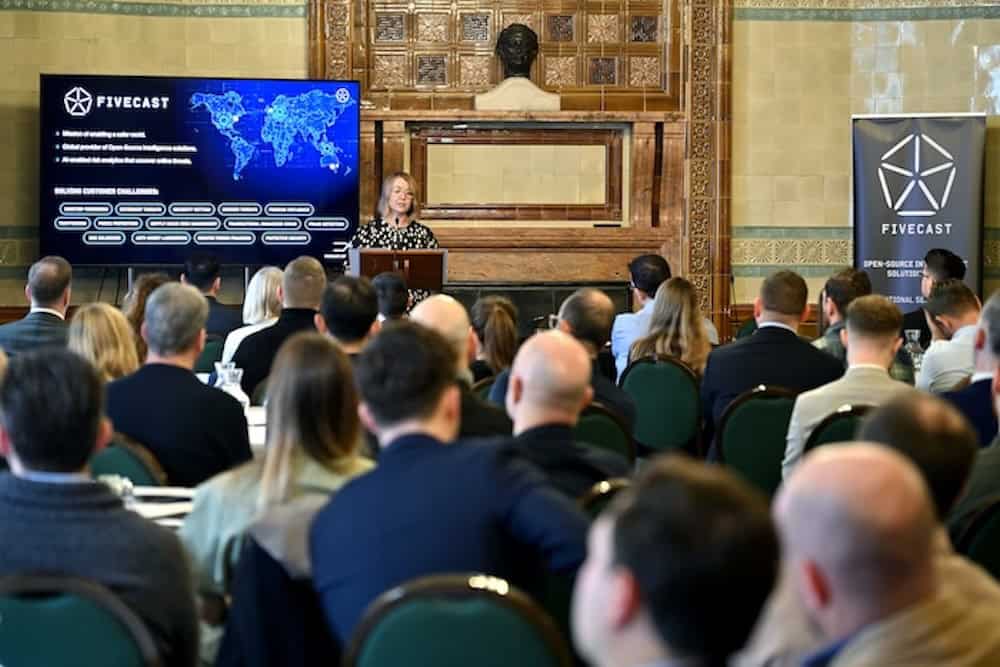
The Fivecast UK team recently brought together intelligence, security, and investigation professionals from across government and industry for the annual OSINT Community of Interest event in London.
Hosted at the National Liberal Club, the event focused on a shared challenge facing modern intelligence teams: how public and private organisations can collaborate more effectively to respond to evolving threats shaped by digital data, online behaviour, and geopolitical instability. Across panel discussions and case studies, a consistent theme emerged. Collaboration is essential, widely supported, and difficult to operationalise in practice.
Alongside the in-depth discussions, the day also struck a lighter note with a fun facts competition about the National Liberal Club, testing attendees’ knowledge of the historic venue. With Fivecast socks up for grabs, it was a simple moment of levity that reinforced the community spirit of the event and encouraged interaction between sessions.
Panel Discussion: Public and Private Collaboration for Resilient Security
The opening panel, Breaking Down Barriers: Public and Private Collaboration for Resilient Security, set the foundation for the day. The session was moderated by Monica Brink, Senior Director of Marketing at Fivecast, and featured Ben Owen, Co-Founder of The OSINT Group; David Benford, Managing Director of Blackstage Forensics; and Jonathan Dunbar, COO and Head of Intelligence at Valinor Intelligence.
A key point of agreement was that intelligence professionals on both sides are highly motivated to collaborate. The challenge lies elsewhere. Policies, procedures, trust, funding, and organisational culture frequently lag behind operational reality. In many cases, intelligence sharing only accelerates once a threat has already escalated.
Panellists discussed how public and private organisations increasingly face the same threat actors and intelligence challenges, including mis and disinformation, foreign interference, insider risk, and threats to critical infrastructure. While these challenges span industries, speakers stressed that collaboration gaps also exist within organisations themselves. As a result, collaboration often remains ad hoc and reactive, both across sectors and across internal departments that must work together to deliver effective outcomes.
The discussion reinforced that collaboration must be designed in advance, not improvised during crises. Trust, governance, and clear frameworks are prerequisites for effective intelligence sharing. Panellists also emphasised that while automation, AI, and open-source intelligence tools are critical to managing scale and speed, they do not replace human judgement. Skilled analysts remain essential for interpretation, validation, ethical decision making, and understanding context.
Session Two: Wildlife Trafficking and Crime Convergence in North Africa
The second session, led by Rhizome Insights, examined wildlife trafficking and crime convergence in North Africa and provided a practical example of how OSINT and HUMINT intersect.
The case study demonstrated how Fivecast ONYX was used to rapidly identify individuals, networks, and digital footprints. The solution’s OSINT capabilities enabled early discovery of personal identifiers, online behaviour, and connections that would have been extremely difficult to surface through traditional methods alone.
These insights then informed human led investigative work, supporting on the ground enquiries and engagement. The session highlighted that while OSINT tools accelerate discovery, it is analysts and investigators who translate insight into action. This reinforced a broader theme of the day: OSINT and HUMINT are not competing disciplines. When integrated effectively, OSINT strengthens HUMINT by providing context, direction, and speed.
Session Three: OSINT to Inform On The Ground Security Support
The third session, presented by Alex Hillier and Simon Margrave of Control Risks, explored how OSINT is used to inform on the ground security operations, including executive protection and physical security planning.
The speakers discussed how open-source data can reveal behavioural indicators, emerging risks, and situational context that directly inform operational decision making. This included monitoring online narratives, identifying escalation indicators, and understanding how individuals and groups may act in physical environments.
A key takeaway was that OSINT often provides early signals that help organisations move from reactive security postures to proactive risk management. This capability is increasingly critical for both public sector agencies and private organisations responsible for people, assets, and major events. As with other sessions, speakers emphasised that technology supports decision making, but analysts remain central to assessing risk and determining appropriate action.
Session Four: Beyond the Beautiful Game. OSINT in Football
The final session, Beyond the Beautiful Game, presented by The OSINT Group, examined the use of OSINT within professional football investigations.
Through real-world examples, the session demonstrated how open-source intelligence supports investigations into integrity issues, organised crime, and associated threats. OSINT was used to uncover networks, track behaviour, and identify risk indicators that would not have been visible through closed data sources alone. Ben Owen used a clear analogy, comparing intelligence work to baking a cake, where having all the right ingredients and following the process is essential to achieving a reliable outcome. This analogy reinforced a broader point echoed throughout the day: effective intelligence requires both strong tooling and human expertise.
The session reinforced the versatility of OSINT across sectors. From national security and law enforcement to sport, corporate security, and financial investigations, OSINT has become mission critical. Danni Brooke, Co-Founder of The OSINT Group, also shared insights from her experience as an undercover police officer and discussed her book Undercover Copper, highlighting the human dimension of intelligence work.
Moving Collaboration Forward
The Fivecast OSINT Community of Interest underscored a clear reality. Public and private sector collaboration is no longer optional..
To move from intent to action, organisations must address the structural barriers that slow collaboration. This includes revisiting policy, aligning processes, and fostering cultures that support responsible intelligence sharing before a crisis occurs.
Fivecast is committed to supporting this community by enabling intelligence professionals to explore open-source data at scale and turn insight into action. While AI and OSINT tools are essential for managing speed, volume, and complexity, the event reinforced that technology does not replace the human analyst. Skilled professionals remain central to interpreting context, exercising judgement, and ensuring intelligence is used responsibly. Events like this are about more than discussion. They are about strengthening the relationships, trust, and human expertise needed to build resilient security outcomes together. Thank you to everyone who attended and brought meaningful discussions to the table.
To stay informed on the latest intelligence news, educational resources, and upcoming Fivecast events, visit the Fivecast Intelligence Hub. It’s where our community of analysts and intelligence professionals share insights, learn from real-world use cases, and continue the conversation beyond the event.
About Fivecast
Fivecast delivers intelligence solutions built for clarity, powered by AI, and trusted to surface what matters. Engineered to solve complex intelligence challenges, our platform cuts through digital noise to help those protecting nations, borders, businesses, and communities uncover critical insights – before risk becomes reality.
Trusted by agencies and enterprises across national security, law enforcement, defense, corporate security, and financial crime, Fivecast was born from collaboration between government and research institutions. Headquartered in Australia with a global footprint, we support the world’s most critical missions.
Fivecast. Engineered for Intelligence.
